Inside Glasgow’s 7,500-deployment Games operation
By the demoduck.co.uk editorial desk
Police Scotland recorded 7,500 deployments during the 11-day Glasgow 2026 Commonwealth Games. That figure describes the volume of operational deployments, not 7,500 individual police officers.
The listed workforce comprised 1,907 officers and 91 police staff, giving a total of 1,998 people and explaining the force’s rounded figure of 2,000 personnel mobilised from across Scotland. They supported an event that welcomed more than 630,000 people to competition venues, live sites and the Glasgow 2026 Festival.
Five figures show the operation’s scale
| Measure | Police Scotland figure |
|---|---|
| Operational deployments | 7,500 |
| Police officers | 1,907 |
| Police staff | 91 |
| Youth volunteers | 118 |
| Planning time | More than 30,000 hours |
| Officer and staff welfare packs | 2,000 |
Planning took place over 18 months with partners across Glasgow, Commonwealth Sport and the organising company. Police Scotland drew personnel from all 13 local policing divisions while continuing to cover communities elsewhere in the country.
The attendance and deployment totals measure different things and cannot be treated as a direct officer-to-visitor ratio. The source does not provide daily staffing levels, deployment lengths or a breakdown by venue, so the figures show the operation’s overall scale rather than how resources were distributed on any particular day.
Security checks began before every venue opened
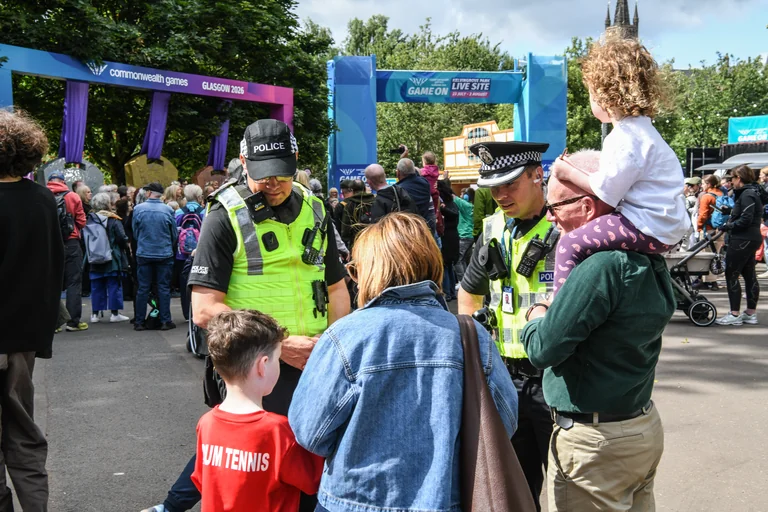
Local and specialist officers conducted daily security checks at each venue before spectators were admitted. Once doors opened, officers patrolled and engaged with athletes, families, fans and other visitors across the city.
Assistant Chief Constable Mark Sutherland, the operation’s Gold commander, said personnel had been instructed to remain vigilant, engage with the public and be prepared to respond. Police Scotland described the atmosphere around the Games as positive and friendly.
The force said the event passed without significant criminality or disruption. That does not mean it was incident-free: five arrests or enforcement cases connected with locations around the Games were listed as of Sunday, 2 August.
They concerned a stolen staff bicycle, alleged offences including resisting arrest and drug possession, a drone flown in restricted airspace, possession of a bladed article in public and refusal to leave licensed premises. The bicycle was recovered, while enquiries into the restricted-airspace drone incident were continuing.
Specialist teams covered venues, roads and airspace
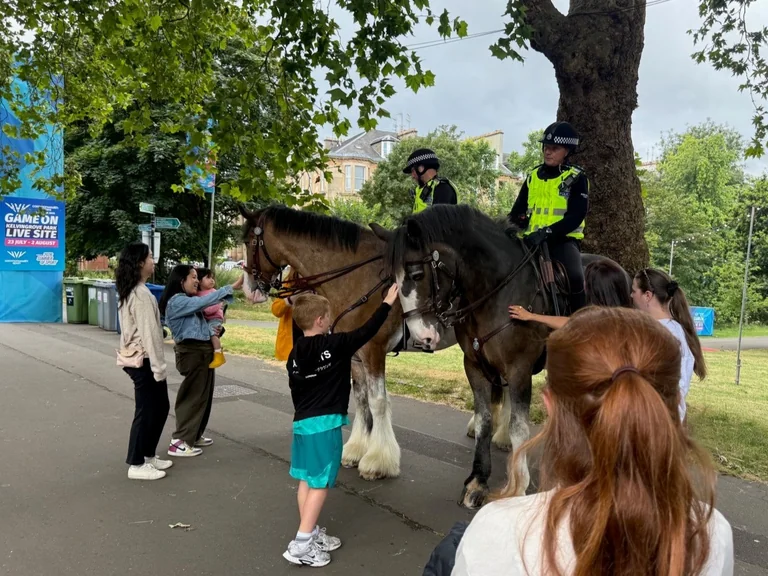
The operation involved mounted officers, armed policing, police dogs and specialist search teams. National capabilities also included intelligence, counter-terrorism, cybercrime, protest liaison, public order, road policing, dive and marine units, air support, drones, logistics and VIP planning.
Their inclusion indicates the range of contingencies covered by the security plan, but Police Scotland did not publish deployment totals for individual units. It is therefore not possible to determine which specialism carried the greatest workload from the post-event figures alone.
The 118 Police Scotland Youth Volunteers had practical roles alongside officers and athletes. At swimming events, they collected poolside kits, handled race accreditation and distributed wellbeing packs to personnel.
Routine policing continued beyond the Games
The national mobilisation ran alongside unrelated police work across Scotland. Police Scotland highlighted the recovery of drugs valued at £2 million in North Lanarkshire and at the port of Cairnryan, the multi-agency response to the Cairngorms wildfire and an investigation following significant disorder at protests in Glasgow Green.
Officers also arrested 15 people in connection with that disorder, while a man was convicted of causing death by dangerous driving in Broughty Ferry. These cases were cited as examples of concurrent work and were not presented as part of the Commonwealth Games arrest total.
Sutherland put the operational pressure plainly: “The demand on policing does not stop.”
Source: Police Scotland News
Context & actions About this article
Source check How this report was checked
This report distinguishes Police Scotland’s confirmed operational figures from conclusions the published data cannot support.
- Checked that 1,907 officers and 91 staff total 1,998 personnel, consistent with the rounde...
- Kept 7,500 deployments separate from the number of individual officers and staff.
- Identified the five listed enforcement cases as accurate only up to Sunday, 2 August.
- Separated concurrent policing elsewhere in Scotland from the Commonwealth Games arrest fig...
- Source
- Police Scotland News
- Scope
- Scotland
- Updated
- 2026-08-03 11:14
Source check
Report a trust issue
Send a clear signal to community moderation if the source, facts or context need review.
Comments