London’s lost eclipse plates head home after 129-year loan
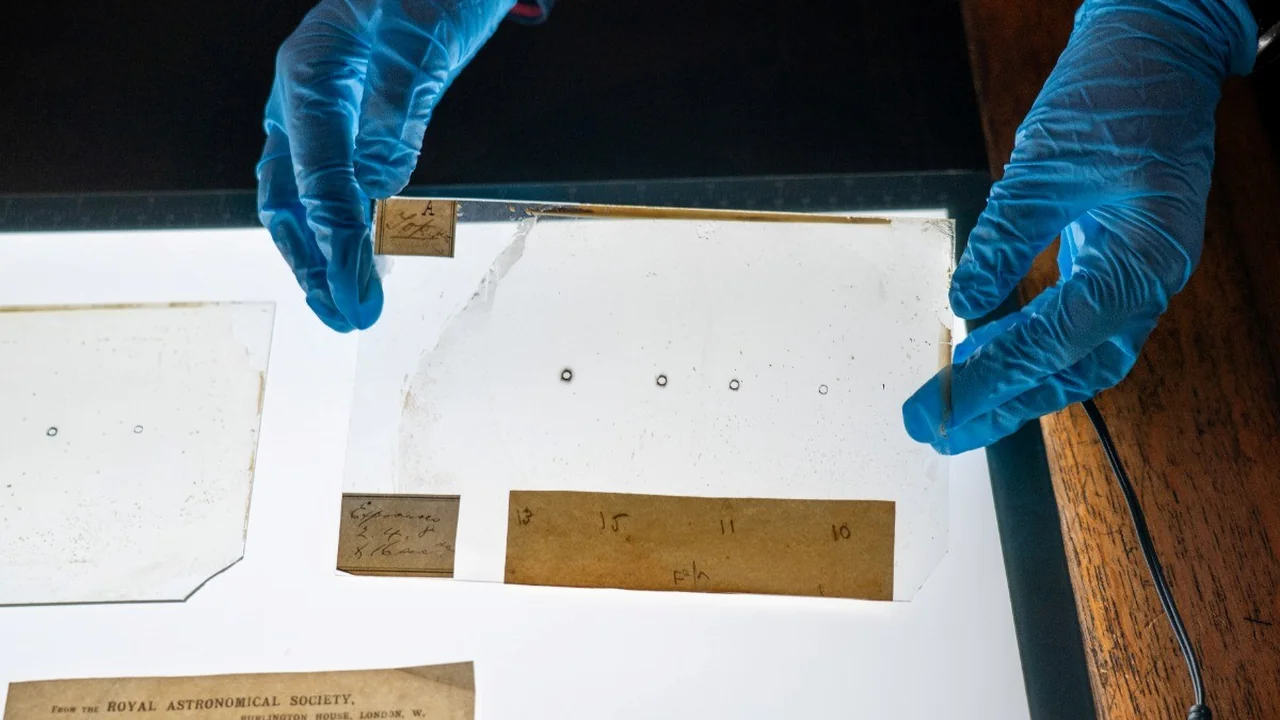
Photographic glass plates made during the 1875 total solar eclipse are returning to the Royal Society library after spending 129 years with its former next-door neighbour, the Royal Astronomical Society in London.
The fragile images were rediscovered during a cataloguing and repackaging project at the Royal Astronomical Society. They are due back at the Royal Society in time for the partial solar eclipse visible from the UK on 12 August 2026.
A loan that outlasted a century
The plates were lent in 1897, when both societies were based at Burlington House. The Royal Society later moved to Carlton House Terrace, while the photographs remained in the Royal Astronomical Society archive.
Keith Moore, the Royal Society’s Head of Library, described the return with a librarian’s dry humour: loans, he said, are always welcome back, even when they are more than a century overdue.
Their rediscovery came through work by intern Keren Edwards, supervised by Assistant Archivist Kate Bond. Sian Prosser, Librarian and Archivist at the Royal Astronomical Society, said the project showed how retrospective cataloguing can bring hidden collections back into view.
The young physicist sent to Siam
The plates record an expedition to Siam, now Thailand, for the total solar eclipse of 6 April 1875. The Royal Society had been invited by King Chulalongkorn, Rama V, whose father King Mongkut had been a keen astronomer and had observed an eclipse in 1868.
Joseph Norman Lockyer, co-discoverer of helium and later founder of Nature, had originally been expected to lead the expedition. His work as secretary to the Royal Commission on Scientific Instruction prevented him from travelling, and responsibility passed to Arthur Schuster.
Schuster was only 23 and based in Manchester when he travelled with Frank Edward Lott and Frederick Beasley, an amateur photographer. In his later account, Schuster recalled fearing that the eclipse might be missed; an international group in Thailand helped the team capture the event.
A record of the Sun’s hidden outer atmosphere
For 19th-century astronomers, total eclipses offered a rare chance to study the corona, the Sun’s outer atmosphere normally overwhelmed by daylight. The expedition’s findings were later published in Philosophical Transactions of the Royal Society, with Lockyer and Schuster describing the corona as surrounding the Moon “like a regular and well-defined star”.
The returned plates sit within a much longer archive of eclipse observation. The Royal Astronomical Society holds records including its 1879 “Eclipse Volume”, which collected observations of total eclipses up to 1878, while the Royal Society preserves eclipse diagrams, colour scales and early viewing devices.
The 1875 photographs now return to the institution that sent the expedition to Siam, carrying a visual record of an observation made before Schuster became a leading figure in British science and international scientific cooperation.
Source: Royal Society News
Context & actions About this article
Source check Source trail
This report follows the Royal Society’s account of the plates’ rediscovery, loan history and planned return.
- Checked the stated 1897 loan date and the 129-year interval.
- Checked the 6 April 1875 eclipse date and the Siam expedition details.
- Checked the named expedition members and archive staff quoted in the announcement.
- Source
- Royal Society News
- Scope
- London
- Updated
- 2026-08-12 16:47
Source check
Report a trust issue
Send a clear signal to community moderation if the source, facts or context need review.



Comments